
Co-Extruded Gasket IP (bi-material)
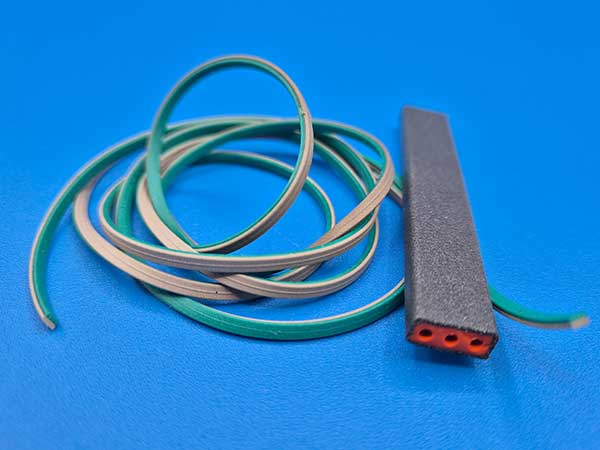
Co-extruded elastomer profiles consist of a conductive elastomer and a non-conductive elastomer. Both materials are extruded at the same time. In addition to having a high level of EMI protection, they also offer a high level of protection against environmental influences. These co-extruded gaskets offer the advantage of being able to save a large part of the conductive particles. Only a small part of the profile is electrically conductive. This product variant represents a very economical alternative to the previously seen conductive particle-loaded silicone gaskets. Large profiles are the big winners of this new technology. The loaded silicone partially covers the joint section, which allows for a very flexible gasket. The addition of conductive loads usually always leads to an increase in hardness and a decrease in tensile strength. We thus obtain bi-material gasket with a more interesting mechanical behavior than pure loaded silicone (better flexibility and therefore better level of IP sealing).
EMI Conductive Gasket
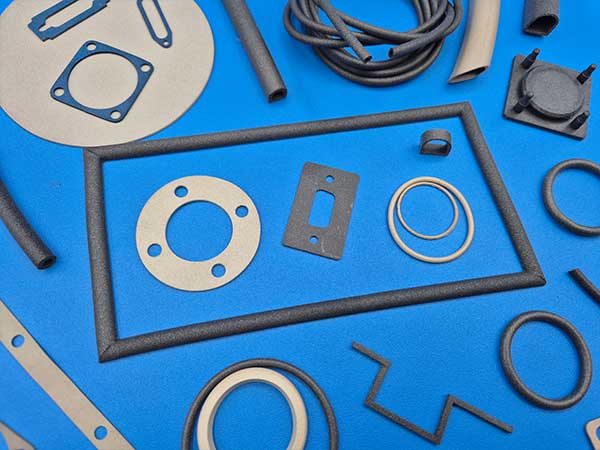
Conductive silicones are composed of a mixture of silicone or fluorinated silicone and conductive metal particles made in an agitator. The particles can be either silver aluminum, silver copper and/or nickel-plated graphite for the most frequently used. These seals come in several forms. They have a temperature range identical to that of «conventional» silicone said unloaded. They have excellent resistance to residual deformation after compression. Fluorinated silicones have a very good resistance to hydrocarbons, oils and solvents more generally therefore to «aggressive» media. These seals «mounted» in groove can be suitable for IP68 with a good recommendation. We also offer Ni/GR seals with the UL94V0 standard and the associated yellow card. The manufacturing processes used are compression molding or extrusion of hollow or solid rope profiles. They are then cut to the required length and then joined («planed») end to end by vulcanization (hot bonding). This hot bonding avoids hard spots and therefore leaks. These processes make it possible to offer a set of tailor-made solutions with short delivery times.
EMI Gasket in Silicone Coated
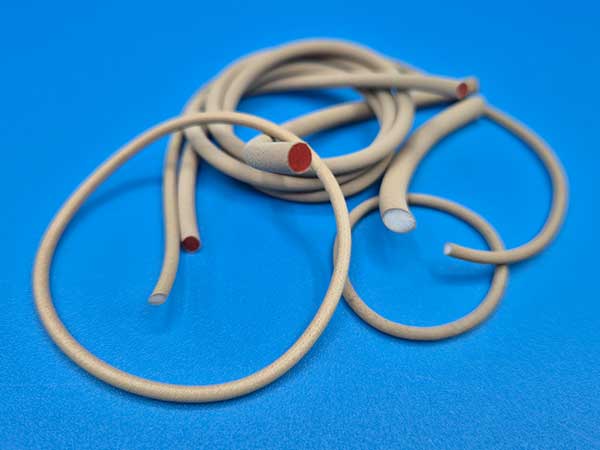
The EMI SIL COATING is a silicone-based gasket, foam-expanded or solid (compact), covered with a thin layer (skin) of Silver & Copper with a thickness of 0.15mm. It therefore makes it possible to achieve sealed joints and electrical conductors It has ideal properties in terms of resistance to pressure and aging. It has high conductivity and very high flexibility (20 to 60 shA). The nature of its outer layer allows it a good galvanic compatibility with almost all supports and consequently to avoid corrosion or galvanic couples. Silver is after gold the best electric conductor. The gasket thus made are reusable after disassembly because they do not contain metal particles likely to damage the surfaces in contact. Moreover, the nature of its internal structure makes it an inexpensive gasket compared to standard silicone seals loaded with Silver/ Copper. The same applies to co-extruded gaskets. These gaskets only exist in O-ring shape!… They are easy to install but require a throat.
EMI Gaskets in Woven Aluminium Wires
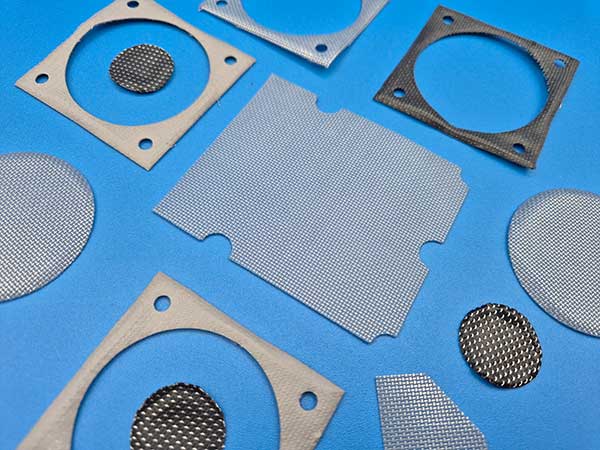
This Cem composite seal is IP 68. It is made of metal canvases and expanded sheets impregnated with silicone. It is highly electrically conductive and has very good resilience for environmental EMI/RFI applications. It is relatively hard and therefore very resistant to tearing. It is at the same time «elastic». It provides an economic response to the gasket of «flat surfaces» because it ensures a very good sealing to pressure and fluids. It is particularly suitable for small thin joints like MIL connectors. The surface irregularities should not exceed 0.10 mm for the use of this gasket. It is especially prescribed in all military applications that require excellent electrical conductivity and low electrical resistance. A fluor-silicone version is available for use with fuels, oils, hydraulic fluids or other contaminants.
EMI SILMEL Gaskets loaded with monel wire

The high-performance SILMEL gasket combine sealing and EMC for all applications of enclosures, enclosures, hatches… outdoors (IP). These gasket are used mainly as connector or base gaskets. They are made of silicone in which is “drowned” wires of Monel or Aluminum. The homogeneity, texture and chemical composition of silicone are not degraded by the presence of these threads. Indeed, they offer good compatibility with most materials. It is rare to notice any galvanic corrosion between the SILMEL seal and its support (even if it is aluminum). The presence of corrugated metal wires positioned perpendicular to the faces embedded in the mass of the silicone, does not affect the sealing function of the gasket. Thus, the resistance to external aggressions (chemicals, fluids…) and the service life are those of pure silicone.
EMI Gasket EMICOMBI IP67 (bi-material)
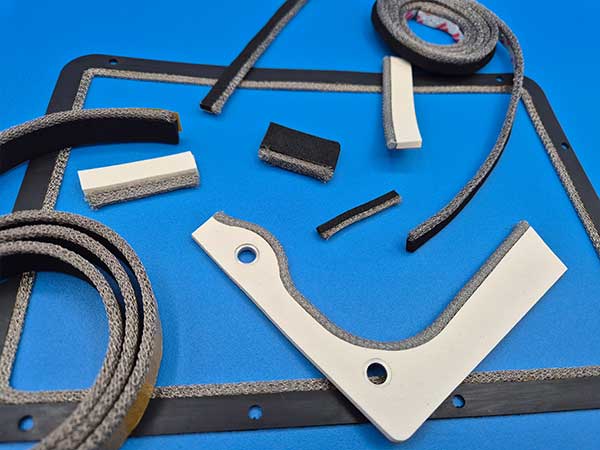
EMI COMBI gasket are high performance EMC/ gasket that provide both RFI/EMI shielding and environmental tightness. The applications are mainly for cabinets, enclosures, enclosures, hatches, etc. Gasket can be supplied for NBC (nuclear, biological and chemical) applications. These joints are made by bonding a strand of metal knitting yarn with a foam or compact elastomer band (Viton, Nitrile, Neoprene, EPDM or Silicone). These gaskets make it possible to achieve a runoff tightness up to IP67. An adhesive is put in place under the elastomeric part to help fasten the gasket. If an IP 68 is requested, in this case it must be ensured that the gasket is placed in a groove without adhesive. The gasket can be supplied in continuous strips or made in the form of closed frames according to customer plan. Compression limiters (stops) can be incorporated into the frame gasket to prevent its damage during assembly, and galvanic compatibility can be optimized through the choice of materials of the knitting yarns used. These gaskets offer an economical solution for high-level RFI/EMI/EMP shielding applications for electric and magnetic fields.